

HEVC IPTV Encoders: The Complete Professional Guide for Modern Streaming Systems
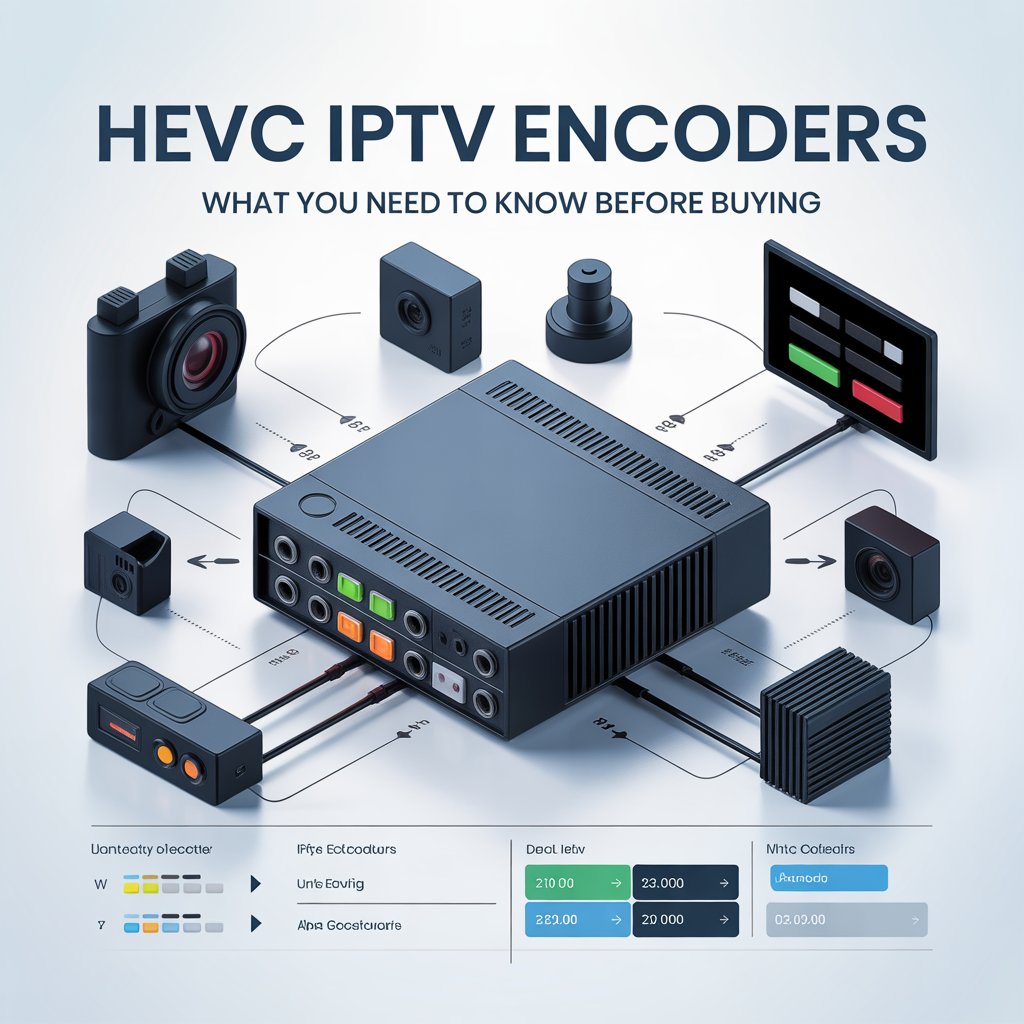
HEVC IPTV Encoders
Professional guide • Updated for modern IPTV deployments
HEVC IPTV encoders are hardware or software systems that compress and convert live and VOD video into HEVC (H.265) streams for efficient IPTV distribution — enabling high-quality HD and UHD delivery with significantly reduced bandwidth.
HEVC IPTV encoders are central to any modern streaming infrastructure. They allow broadcasters, ISPs, hoteliers, and content owners to deliver premium video (HD, 4K) while using far less bandwidth than older codecs. This guide explains what HEVC encoders do, why they matter, how to choose them, and how to deploy them for reliable, high-quality IPTV services.
What are HEVC IPTV encoders?
At their core, HEVC IPTV encoders take raw or pre-processed video inputs and compress them using the HEVC (High Efficiency Video Coding, H.265) standard, producing streams suitable for IPTV distribution.
Inputs commonly include HDMI cameras, satellite receivers, SDI — even IP-origin sources — and the encoder outputs may be UDP/RTP, HLS, SRT, RTMP, or segmented HLS for adaptive delivery.
Common input and output types
- Inputs: HDMI, 3G/12G-SDI, CVBS, ASI, IP (RTSP/RTMP/UDP)
- Outputs: UDP/RTP multicast, HLS (VOD/OTT), SRT, RTMP, MPEG-TS over IP
Encoders may be dedicated rack appliances (hardware) or software running on servers or cloud instances. Both types implement HEVC compression but differ in performance, reliability, and cost.
Why HEVC (H.265) matters in modern IPTV systems
HEVC is the successor to H.264 and was designed to deliver similar visual quality at roughly half the bitrate. For IPTV providers, that efficiency translates into lower operational costs, more channels per multiplex, and the ability to offer 4K without breaking the network.
Technical advantages
- Up to 50% bitrate reduction compared to H.264 for comparable quality.
- Support for resolutions from SD to 8K with better motion handling.
- Improved intra- and inter-frame prediction mechanisms.
- Enhanced tools for noise and artifact reduction at low bitrates.
Because HEVC reduces required bandwidth, it’s especially valuable where network capacity is limited or expensive: satellite links, mobile data, corporate WANs, and hospitality networks.
Benefits of HEVC IPTV encoders for IPTV providers
Moving to HEVC IPTV encoders provides operational, technical, and user-experience advantages. Below are the most impactful benefits and real-world effects.
1. Lower bandwidth usage
With HEVC, a 1080p stream can often be delivered at 40–50% less bitrate than with H.264. That means:
- Lower transit and CDN costs
- More concurrent viewers per Mbps provisioned
- Smaller CDN footprint and lower egress fees
2. Improved image quality
HEVC preserves fine detail and handles high-motion content more gracefully, which benefits sports, live events, and action-heavy programming.
3. 4K and UHD distribution becomes feasible
HEVC makes 4K realistic for cable operators, ISPs, and OTT platforms by reducing per-stream bandwidth to a manageable level.
4. Reduced storage and CDN costs
VOD libraries compressed with HEVC occupy less space, saving on cloud storage and delivering cost-effective long-term archiving.
5. Mobile and limited-bandwidth friendliness
Viewers on mobile networks benefit from lower data consumption and fewer rebuffering events.
Key features to look for in HEVC IPTV encoders
Not all encoders are created equal. When selecting an HEVC IPTV encoder, prioritize features that match your operational needs and growth plans.
Essential features checklist
- Multi-bitrate (ABR/MBR) output: simultaneous renditions for adaptive streaming.
- Protocol support: HLS, MPEG-TS, RTMP, SRT, UDP, RTP, RTSP.
- Low-latency modes: required for live sports and interactive streams.
- Hardware acceleration: ASIC, FPGA, or GPU options to scale with less heat and power.
- Management UI & API: RESTful APIs and web dashboards for orchestration and monitoring.
- Redundancy & reliability: hot-swap power, watchdog, and failover capabilities for 24/7 operation.
- Closed captions & subtitles: CEA-608/708, DVB subtitles, and timed text support.
- DRM & security: integration points for DRM systems, tokenization, and secure transport (SRT/DTLS).
Advanced features to consider
- HDR (HDR10, HLG) and color space handling for UHD workflows.
- Audio transcoding and multi-audio track support (AAC, AC-3, E-AC-3).
- Auto-framerate and adaptive GOP configuration.
- Edge encoding and container support (fMP4, CMAF).
HEVC IPTV encoders vs H.264 encoders
Choosing between HEVC and H.264 still depends on device support, licensing, and the existing ecosystem. Below is a practical comparison to help decision-making.
| Aspect | H.264 | HEVC (H.265) |
|---|---|---|
| Compression efficiency | Good | ~40–50% better |
| 4K support | Possible but bandwidth-heavy | Designed for UHD efficiency |
| Hardware support | Widespread, legacy devices | Growing; modern devices support natively |
| Encoding complexity | Lower CPU cost | Higher CPU/GPU cost, but accelerated hardware available |
| Licensing | Established licensing models | More complex patent pools and licensing |
In many deployments, HEVC is used at the headend (for delivery and CDN egress) while H.264 remains as a compatibility layer for older end-user devices.
Hardware vs. Software HEVC IPTV encoders
Both approaches are valid. Your choice should reflect scale, budget, maintenance capability, and latency requirements.
Hardware encoders (appliances)
Pros:
- High reliability for 24/7 operations
- Low-latency, deterministic performance
- Professional I/O (SDI, ASI, multi-HDMI)
- Lower long-term TCO for high-utilization scenarios
Software encoders (server/cloud)
Pros:
- Low initial cost and flexible scaling
- Rapid updates and integration with cloud workflows
- Good fit for bursty or on-demand workloads
A hybrid approach is common: hardware encoders in critical headends, software encoders for cloud-origin transcoding and regional edge processing.
Use cases across industries
HEVC IPTV encoders are used across many verticals where efficient, high-quality video matters.
ISPs and Telcos
Telecom providers use HEVC encoders at regional headends to maximize channel counts, reduce CDN costs, and deliver UHD packages.
Hotels & Hospitality
Hotels deploy HEVC to serve high-quality in-room entertainment without overloading internal networks, especially in older wiring environments.
Education & Corporates
Universities and enterprises use encoders for lecture capture, town halls, and secure internal streams.
Sports & Live Events
Low-latency HEVC encoders enable multi-camera feeds, instant replays, and immersive viewing experiences.
Government & Public Sector
Public-access channels, council streaming, and secure internal distribution rely on robust HEVC workflows.
Recommended architectures & deployment patterns
A proper architecture balances cost, latency, device compatibility, and reliability. Below are common patterns.
Local Headend (On-prem)
- Ingest (satellite/antenna/HD-SDI)
- HEVC IPTV encoder (hardware appliance)
- Multiplex / Middleware
- CDN or multicast on ISP network
- STBs, Smart TVs, Apps</li >
Cloud + CDN
- Local encoder or cloud ingest
- Cloud transcode (if needed)
- Origin + CDN (HLS/CMAF)
- Adaptive playback to devices
Edge Encoding (Emerging)
Edge encoders reduce latency and offload central resources. Common for stadiums and remote broadcast points.
Hybrid Satellite + IPTV (Hospitality)
Satellite receivers feed HEVC encoders which then distribute channels over the hotel’s IPTV network — ideal for multi-language and private channel lists.
Performance optimization & troubleshooting tips
HEVC encoding demands careful tuning. These practical tips help you optimize quality and stability.
Multi-bitrate profiles (recommended starting points)
- 4K UHD: 12–18 Mbps HEVC (subject to content complexity)
- 1080p: 3.5–6 Mbps HEVC
- 720p: 2–3 Mbps HEVC
- 480p/SD: 0.8–1.5 Mbps HEVC
Actual bitrates depend on content complexity and desired visual fidelity. Use two or three ABR renditions per target resolution where possible.
Latency tuning
- Shorten GOP length for lower latency (but at the cost of compression efficiency).
- Use low-latency HLS or CMAF if you target HLS playback.
- Consider SRT or WebRTC for sub-second or low-second latency in live interactive applications.
Hardware & thermal considerations
HEVC encoders (especially software ones) can tax CPUs and GPUs. Monitor temperatures, and prefer appliances with active cooling or GPU acceleration where possible.
Monitoring & metrics
Track key metrics: encoding CPU/GPU usage, dropped frames, bitrate stability, packet loss, and end-user QoE (startup time, buffering events).
Troubleshooting checklist
- Confirm input signal integrity (no frame drops on SDI/HDMI).
- Validate encoder logs for alarms and reboots.
- Check network path: packet loss & jitter to CDN/edge.
- Compare playback across devices to isolate client compatibility issues.
- Ensure keyframe (I-frame) alignment for seamless stream switching in ABR.
Future trends in HEVC IPTV encoders
The streaming landscape continues to evolve. Several trends will impact how HEVC IPTV encoders are adopted and designed.
1. Wider UHD & HDR adoption
More channels and VOD in HDR and 4K will drive demand for HEVC-capable hardware everywhere.
2. AI-assisted encoding
Machine learning will enhance perceptual compression, choosing bitrate allocation frame-by-frame for better perceived quality.
3. Edge & distributed encoding
Pushing encoding closer to the viewer reduces latency and CDN dependency for live events.
4. AV1 and codecs landscape
AV1 is gaining traction for web/OTT, but HEVC remains important due to broad hardware acceleration and live broadcast acceptability. Many providers will run mixed-codec environments for years.
FAQs: Quick answers about HEVC IPTV encoders
Q: Is HEVC supported on all devices?
Native support varies. Most modern TVs, set-top boxes, and mobile devices support hardware-accelerated HEVC, but some legacy devices may need H.264 fallbacks or software decoders.
Q: Does HEVC reduce CDN costs?
Yes — when bandwidth is the primary driver of cost, HEVC can materially reduce CDN egress and transit fees by lowering per-stream bitrates.
Q: When should I stick with H.264?
If your audience uses older devices that lack HEVC support and you cannot control the client app, H.264 compatibility may be necessary as a fallback.
Q: What are common HEVC licensing considerations?
HEVC is subject to patent pools and licensing fees. Vendors and large-scale operators often negotiate licensing arrangements or select vendors that include licensing in the product price.
Internal & external link placeholders
Use these placeholders to link to further reading and authority sources:
Sample encoder specification — recommended baseline
This is a typical spec checklist to request from vendors when evaluating HEVC IPTV encoders.
- HEVC (H.265) Main/Main10 profile support
- 4Kp60 input and encoding capability
- Simultaneous multi-bitrate outputs (min. 4 renditions)
- Protocols: HLS (CMAF), MPEG-TS, SRT, RTMP, UDP
- Hardware acceleration: ASIC/FPGA or NVENC/NVDEC support
- Redundant PSU (for rack units)
- Extensive API and SNMP monitoring
- Closed caption/subtitle passthrough
- Temperature & power consumption metrics
Deployment checklist (quick)
- Map input sources and required outputs.
- Choose hardware vs software based on uptime and scale.
- Plan ABR ladder and CDN strategy.
- Configure monitoring, logging, and alerting.
- Test on representative client devices (STBs, mobile, web, Smart TVs).
- Verify DRM and content protection workflows.
- Run load tests and failover simulations.
Note about patents and licensing
HEVC is covered by several patent pools and licensing terms that can affect vendor costs. Consult your legal and procurement teams when finalizing vendor contracts or deploying at scale.
Conclusion
HEVC IPTV encoders are a strategic asset for any organization that delivers video at scale. They reduce bandwidth, enable UHD, and improve the end-user experience while helping operators control costs.
Whether you are upgrading a hotel IPTV system, building a telco-grade headend, or launching an OTT service with UHD ambitions, HEVC offers powerful benefits — especially when combined with well-architected delivery and monitoring.
Ready to upgrade your streaming platform?
If you’re evaluating HEVC IPTV encoders and want practical recommendations tailored to your network and audience, get in touch. We can help you with vendor selection, ABR ladder tuning, and pilot deployments.
Contact us for a custom HEVC encoder plan →
Prefer to read more first? Check these:
